

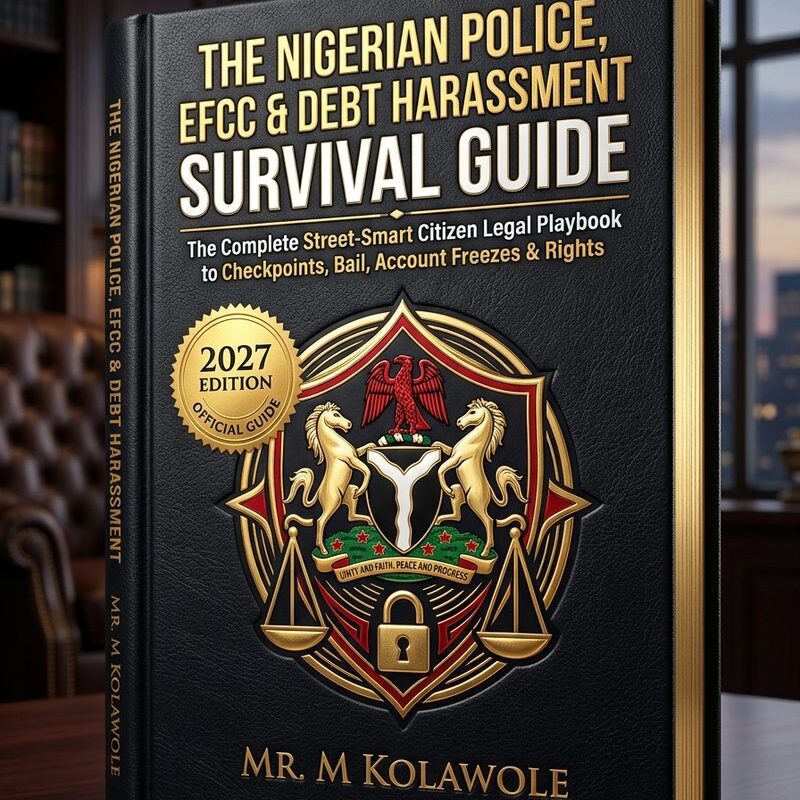
The Nigerian Police, EFCC & Debt Harassment Survival Guide
Authored by Mr. M Kolawole. The definitive street-smart legal handbook designed to safeguard your liberty, privacy, bank balances, and dignity at checkpoints, police stations, anti-graft interrogation rooms, and against digital loan sharks.
Instant PDF Download • Read on Phone, Tablet, or Laptop • 8 Ready-to-Use Legal Templates Included
Every single day in Lagos, Abuja, Port Harcourt, Ibadan, and across Nigerian highways, law-abiding citizens experience sudden, terrifying encounters with armed security personnel and predatory institutions. You are driving home from work, commuting with your laptop bag, or simply using your smartphone at a bus stop, and suddenly you are flagged down: “Park well. Step out. Unlock your phone. Open your banking app.”
Or worse, you wake up to discover your bank account slapped with an arbitrary Post-No-Debit (PND) freeze because of an innocent crypto peer-to-peer (P2P) transaction or an informal police investigation letter. Meanwhile, aggressive digital loan sharks harvest your phone contacts and blast defamatory messages, fake obituaries, and criminal wanted posters to your parents, employers, and church members.
In Nigeria, ignorance of statutory law does not just cost you money: it costs you your liberty, reputation, and peace of mind. Rogue officers and predatory lenders thrive because most citizens do not know the exact statutory provisions that protect them.
To put an end to this cycle of intimidation and extortion, seasoned legal educator and human rights advocate Mr. M Kolawole has published the definitive survival manual: The Nigerian Police, EFCC & Debt Harassment Survival Guide.
Why Citizens Suffer Extortion & Abuse in Nigeria
Enforcement abuse rarely happens because an officer lacks a uniform. It happens because citizens do not know where official police powers end and where unconstitutional abuse begins:
- The Roadside Phone Search Myth: Millions believe police officers have blanket authority to rummage through their WhatsApp chats, photos, emails, and crypto apps at checkpoints. Under Section 37 of the 1999 Constitution and repeated Inspector-General of Police (IGP) Force Orders, roadside digital searches without a court-issued search warrant are completely unlawful.
- Weaponizing Police for Debt Recovery: Creditors frequently bribe officers to arrest debtors over business disputes, broken contracts, or unpaid loans. Under Section 8(2) of the Administration of Criminal Justice Act (ACJA) 2015 and Supreme Court precedent, police officers are legally barred from arresting citizens over civil contractual debts.
- The “Bail Paper & Fuel Money” Extortion Racket: Despite bold signs declaring “Bail is Free”, desk sergeants routinely demand between N50,000 and N250,000 for bail processing and reject female sureties on illegal gender grounds.
- Unlawful Administrative Bank Freezes: Commercial banks routinely freeze customer funds upon receiving simple letters from police commands or anti-graft operatives without obtaining the mandatory ex-parte High Court freezing order required by Section 34 of the EFCC Act.
- Cyber-Blackmail by Digital Loan Apps: Predatory lenders deceive borrowers into granting contact and gallery permissions, violating Section 24 of the Cybercrimes Act, the Nigeria Data Protection Act 2023 (NDPA), and FCCPC consumer guidelines.
Comprehensive Breakdown: The 4 Core Survival Modules
Written in clear, punchy, conversational Nigerian English, this handbook breaks down complex procedural statutes into immediate, actionable street wisdom:
Module 1: Police Checkpoints, Stop-and-Search & Street Encounters
Understand the statutory boundaries of Section 29 of the Police Act 2020 (Reasonable Suspicion). Learn exact word-for-word scripts to say and what NOT to say when an officer barks “Unlock your phone”. Discover rules on physical searches for female citizens under Section 54 of ACJA 2015, car trunk inspections, tinted glass permit realities, digital CMRIS registration truths, and tactical de-escalation methods to survive armed encounters safely.
Module 2: The Police Station, Bail & Detention Rights
Bust the station counter myth using Section 167(3) of ACJA 2015, which guarantees that women can stand surety. Master the constitutional 24/48-hour detention deadline under Section 35(4) and (5), demolish the notorious “Friday arrest trap”, and defeat illegal “holding charges”. Learn how Nigerian High Courts award between N5,000,000 and N50,000,000 in damages against police brutality and illegal detention under the Fundamental Rights (Enforcement Procedure) Rules 2009.
Module 3: EFCC, ICPC & Financial Crimes Investigations
Distinguish between informal invitation letters and court arrest warrants. Prepare for anti-graft interviews with a mandatory documentary checklist. Identify dangerous trap words (such as “I promise to refund”) in cautionary statements that prosecutors exploit to turn civil breaches into criminal convictions. Learn the exact 7 to 14-day legal procedure to unfreeze bank accounts hit with administrative Post-No-Debit (PND) restrictions and recover damages against negligent banks.
Module 4: Digital Loan Sharks & Debt Harassment
Expose the predatory playbook of illegal loan apps. Enforce Section 24 of the Cybercrimes Act, the Nigeria Data Protection Act (NDPA 2023), and FCCPC joint taskforce regulations. Follow systematic administrative reporting steps to Google Play Store, FCCPC, and CBN, and preserve evidence to sue for multi-million Naira civil libel damages. Learn the lawful debt recovery process via formal Demand Letters, Multi-Door Courthouse mediation, and the Small Claims Court.
8 Ready-to-Use Citizen Legal Templates Included
This survival guide equips you with courtroom-tested, ready-to-copy legal instruments:
- Pocket Checklist: What to Do at a Police Checkpoint: A wallet-sized practical protocol for safe roadside navigation.
- Formal Petition to Police Complaints Response Unit (CRU) & Police Service Commission (PSC): To sanction corrupt officers and recover extorted funds.
- Formal Demand Letter to Bank Legal Department: To lift illegal administrative Post-No-Debit (PND) account freezes within 48 hours.
- Formal Cease-and-Desist Notice: To stop defamatory messages and cyber-blackmail by rogue digital lending apps.
- Sample Fundamental Rights Enforcement Originating Motion: Standard High Court application structure claiming damages for unlawful arrest and detention.
- Surety Administrative Bail Application Letter: Professional template for securing prompt, free police station bail.
- Directory of Verified Human Rights Emergency Oversight Agencies: Key headquarters and contact information for NHRC, CRU, PSC, FCCPC, NDPC, and LACON.
- Plain-English Glossary of 25 Essential Criminal & Human Rights Terms: Demystifying terms like Habeas Corpus, Dud Cheque, Holding Charge, and Garnishee Proceedings.
Never Walk Unprotected on Nigerian Streets
Whether you are a young tech worker carrying an iPhone and laptop, a crypto trader safeguarding your bank accounts, a driver navigating daily checkpoints, or a borrower facing rogue shakedowns, this book is your ultimate legal shield.


As a remote software developer carrying a MacBook around Lagos, checkpoints used to be terrifying. Learning Section 29 of the Police Act and the exact phrases to say without provoking officers changed everything. This guide is a lifesaver.
The chapter on crypto and phone searches is 100 percent accurate. Officers try to criminalize crypto apps when there is no such penal code offense. Having the court precedents handy makes a massive difference.
Illegal loan apps were harassing my contacts and posting fake obituaries because a friend listed me as guarantor without my knowledge. Chapter 6 on FCCPC petitions and cyberstalking complaints stopped them immediately.
The bail playbook in Chapter 4 is essential knowledge for every Nigerian family. The police claim bail is free while station counters demand hundreds of thousands. Knowing how to engage the DPO and legal aid council is vital.
Police converting commercial debt disputes into criminal fraud allegations is one of the biggest abuses in Nigeria. Mr. M Kolawole explains Supreme Court rulings showing police have zero debt-recovery powers.
Clear, fearless, and deeply researched. The emergency card template is now saved on my phone home screen. Every young Nigerian on the road needs this knowledge.
Accurate and timely publication. The Fundamental Rights Enforcement Procedure Rules are explained in plain language that non-lawyers can easily grasp and use.
Purchased for my sons who drive between Lagos and Ibadan regularly. The de-escalation scripts and checkpoint rights gave them so much confidence. Thank you LawTalks!
Excellent guide on handling invitations from anti-graft agencies. The dos and don’ts of statement writing saved someone close to me from signing a self-incriminating document.
This guide belongs in every Nigerian home, glove compartment, and school bag. Practical civic education at its highest standard.